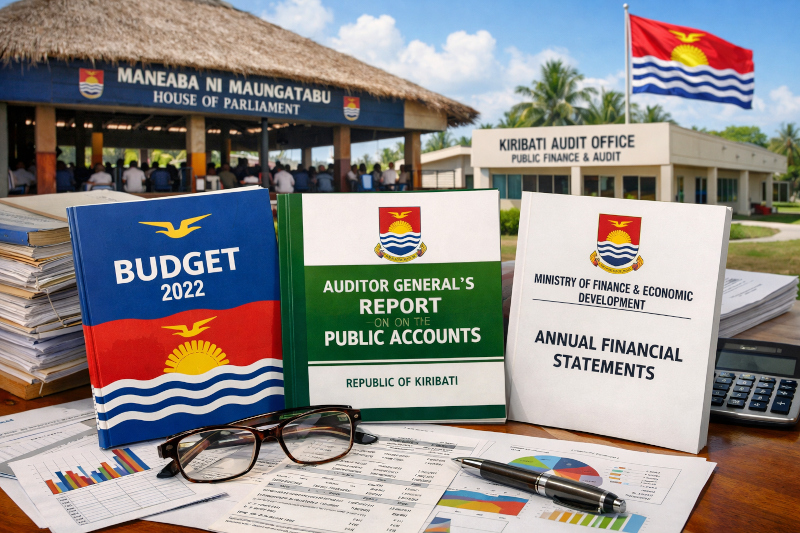
This section provides access to Kiribati’s official reports and publications, offering a transparent view of government finances, development planning, sectoral performance, and donor-funded programs. Together, these documents support accountability, evidence-based policymaking, and public oversight.
1. Government Annual Accounts
Transparency and accountability in Kiribati are reinforced through the annual publication of comprehensive government financial reports.
Each year, the Ministry of Finance and Economic Development (MFED) releases the Government Annual Account, a detailed financial statement covering revenues, expenditures, budget execution, fund balances, and liabilities for the fiscal year. These accounts are a core instrument of public financial management and compliance with international standards.
Independent oversight is provided by the Kiribati Audit Office (KAO), established under Section 114 of the Constitution. The KAO publishes audited Government Annual Accounts and sector-specific audit reports, which are formally tabled in the Maneaba ni Maungatabu (House of Assembly) for parliamentary scrutiny.
All reports are publicly available through official portals such as mfed.gov.ki and kao.gov.ki. The 2024 Annual Account marked a milestone as the first fully generated through the Integrated Financial Management Information System (IFMIS), enabling faster and more accurate reporting. Ongoing reforms supported by the World Bank aim to reduce audit publication timelines from two years to six months.
2. Development Plans and Strategy Documents
Kiribati maintains a strong tradition of strategic planning aligned with both national priorities and international development frameworks.
The government regularly publishes progress reports on core strategies, including the Kiribati 20-Year Vision (KV20) 2016–2036 and the Kiribati Development Plan (KDP). Mid-term reviews and Voluntary National Reviews (VNRs) submitted to the United Nations track progress toward the Sustainable Development Goals (SDGs).
These documents are coordinated by MFED and integrate sector-specific strategies such as:
-
National Infrastructure Investment Plan (NIIP)
-
National Energy Policy targeting 100% renewable energy
-
Ministry Strategic Plans
All reports are publicly available and allow stakeholders to monitor development outcomes, fiscal priorities, and long-term national objectives.
3. Sectoral and Ministerial Reports
Individual ministries and agencies publish annual or bi-annual reports documenting activities, expenditures, and progress toward sector-specific goals. These reports form a critical layer of operational transparency.
Key examples include:
-
Ministry of Health and Medical Services: Annual Health Bulletins, health financing assessments, and system performance indicators
-
Ministry of Finance and Economic Development: Management Reports, sovereign wealth fund (RERF) reports, poverty and inequality analyses
-
Ministry of Foreign Affairs: Annual reports on diplomacy and international engagement
-
Ministry of Education: Reports on enrollment, learning outcomes, teacher training, and education reforms
-
National Statistics Office: Census data, household surveys, poverty and food security reports
Together, these publications provide detailed insight into sector-level performance across the country.
4. Donor and Project Reports
Kiribati works closely with bilateral and multilateral development partners, who publish detailed project and program reports to ensure transparency and accountability.
Major reporting partners include:
-
World Bank
-
Asian Development Bank (ADB)
-
Australia (DFAT)
-
United Nations agencies
-
IFAD, IMF, and other international institutions
These reports document financing, implementation progress, results, safeguards, and evaluations of donor-funded projects. Data from donor reports are integrated into national reporting systems, including budget execution reports, KDP reviews, KV20 monitoring, and SDG reporting.
5. Education, Technology, and Digital Transformation Reports
The Ministry of Education publishes extensive reports on education development, with a strong focus on digital transformation and technology integration.
These include:
-
Education sector annual reports
-
Kiribati Education Improvement Program (KEIP) reports
-
ICT in Education Master Plans
-
E-learning platform performance reports
-
Teacher training and digital skills development reports
-
COVID-19 remote learning response assessments
These documents track progress in access, quality, equity, and innovation across Kiribati’s geographically dispersed education system.
6. Social Protection and Gender Equality Reports
The government produces comprehensive reports on social protection policies and gender equality initiatives, reflecting a strong commitment to inclusion and poverty reduction.
Key reporting areas include:
-
Senior Citizens Allowance (SCA)
-
Support Fund for the Unemployed (SFU)
-
Disability Support Allowance (DSA)
-
Poverty and inequality assessments
-
Gender equality and gender-based violence prevention
-
Child protection and family support programs
Annual reports provide gender-disaggregated data, fiscal analysis, and outcome monitoring aligned with national development priorities and international commitments.
Purpose of the Reports Section
By maintaining a comprehensive and accessible reporting system, Kiribati demonstrates its commitment to:
-
Transparency and accountability
-
Evidence-based policymaking
-
Parliamentary and public oversight
-
Donor coordination and development effectiveness
This Reports section serves as a central reference point for citizens, researchers, investors, development partners, and civil society seeking reliable information on Kiribati’s governance and development progress.